



Iranian scientist discovers new luminescent variety in calcite family

Tehran, IRNA – A prominent Iranian researcher and scientist, Majid Mollanadali Pishnamaz, has discovered a unique luminescent (phosphorescent) variety within the calcite family.
Mollanadali Pishnamaz published his discovery in an article on June 6, 2026, titled “Descriptive Mineralogy and Luminescence Analysis.”
1. Introduction and Background
In mineralogy, the distinction between a mineral species and a mineral variety is determined by crystal-lattice structure and chemical composition. When a well-known mineral, such as calcite, develops distinctive physical or optical properties because of particular impurities, lattice defects, or formation conditions not observed in standard specimens, it may be classified as a variety.
According to the report, Imanite falls within this category. Its primary calcite structure is retained, while the presence of specific elements is said to produce a distinctive photonic, or optical, behavior not typically observed in common calcite. The report also notes that the specimen was given to Professor Majid Mollanadali Pishnamaz by his father and is currently preserved in a safe deposit box because of its reported importance and unusual characteristics.
2. Abstract
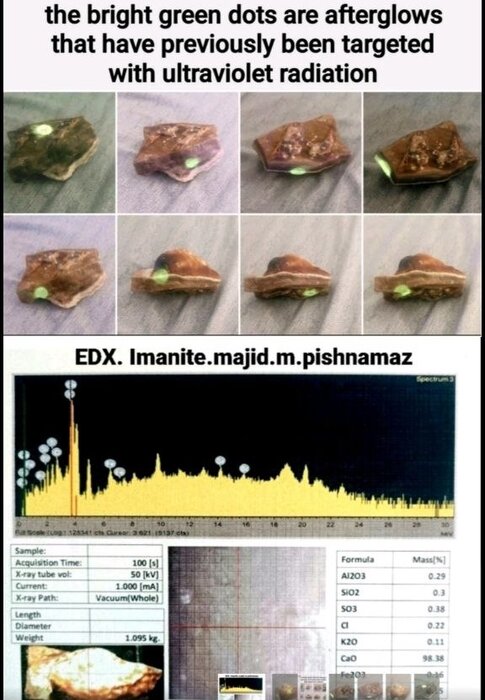
The report presents Imanite as a newly identified variety of calcite (CaCO₃). It states that, unlike standard calcite specimens, Imanite displays a distinctive and stable green phosphorescence, or afterglow, when exposed to ultraviolet (UV) radiation. Although the calcite crystal structure is maintained, the reported optical phenomenon is attributed to specific isomorphic substitutions within the crystal lattice, distinguishing the variety from conventional calcite.
3. Experimental Analysis
3.1. X-Ray Diffraction (XRD) Analysis
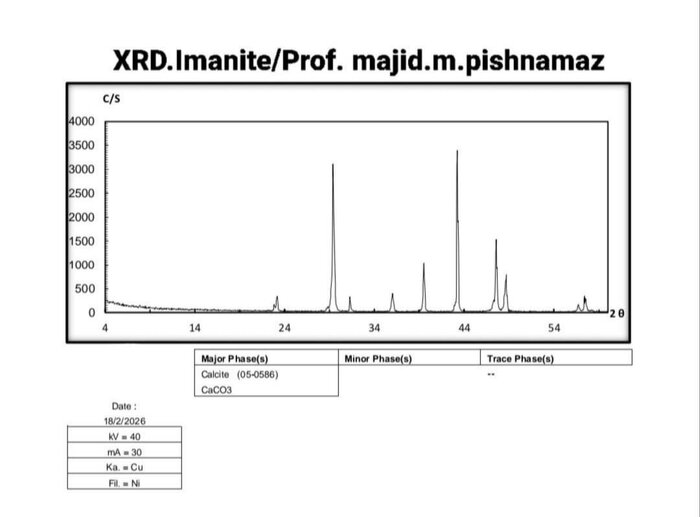
According to the XRD results presented in the report, the sample’s primary and dominant phase is calcite with a very high degree of crystalline order. The diffraction pattern reportedly contains no additional peaks indicating secondary phases or separate crystalline impurities. On this basis, the report classifies Imanite not as a new mineral species with a distinct structure, but as a variety hosted within the calcite lattice.
3.2. Energy-Dispersive X-Ray (EDX) Spectroscopy
According to the EDX data, the sample has a very high calcium content, expressed as a CaO equivalent of 98.38%. The analysis also identifies trace amounts of SrO (0.15%), SO₃ (0.38%), and Al₂O₃ (0.29%). By correlating the XRD and EDX findings, the report concludes that these elements did not form separate phases but were incorporated into the calcite lattice as a solid solution through isomorphic substitution.
4. Optical Properties and Phosphorescence Mechanism
The report identifies luminescent behavior as Imanite’s most distinctive feature. Under UV irradiation, the mineral reportedly emits a green phosphorescence that remains visible for more than three seconds. The report attributes this afterglow to electron traps created by impurities such as strontium within the calcite lattice. The uniform and repeatable response observed across the specimen is presented as evidence of a homogeneous distribution of activators within the Imanite structure.
5. Conclusion
The report concludes that the identification of Imanite as a variety within the calcite family may contribute to the study of minerals with specialized optical properties. It states that the combination of the calcite structure and substitutional impurities has produced a stable optical system with potential relevance to photonics and optical mineralogy.
The report records a specific gravity of 2.662 and a hardness of approximately 3 for the specimen.
6. Origin and Age of Imanite
Professor Pishnamaz’s previous investigations place the specimen’s probable origin near the entrance of a cave. The report considers a cave environment the most likely setting and notes that this interpretation is consistent with the sample’s calcitic nature. Many caves develop in limestone formations, where infiltrating water dissolves calcium carbonate as it moves through limestone layers and later redeposits it as calcite crystals within the cave or around its entrance.
According to Professor Pishnamaz, Imanite most likely represents a form of cave calcite or a crystalline speleothem deposit produced by the gradual precipitation of calcium-carbonate-rich solutions near a cave entrance. The presence of strontium, aluminum, and sulfate compounds may indicate that groundwater moved through specific geological pathways and introduced trace elements into the calcite crystal lattice. The report suggests that these elements played an important role in the specimen’s distinctive optical behavior, particularly its stable green phosphorescence lasting more than three seconds. It further proposes that the uniform afterglow may reflect formation in a calm, humid, low-light cave environment marked by slow mineral deposition. Under such conditions, gradual crystal growth would allow activator impurities sufficient time to enter the calcite lattice. These settings are commonly associated with cave entrances or semi-interior cave zones, where air exchange, humidity fluctuations, and the movement of calcium- and carbonate-rich water can support the growth of transparent, translucent, or optically distinctive crystals.
Based on the proposed cave origin and the reported absence of evidence for metamorphic processes or strong volcanic or hydrothermal sources, the report infers that Imanite formed under low-temperature geological conditions. It estimates an approximate formation temperature of 10 to 30 °C, consistent with natural cave and shallow-groundwater environments. The report adds that warmer mineral waters, if involved, could have raised the formation temperature to approximately 40 °C.
The report cites Professor Pishnamaz as stating that cave calcites may range in age from several thousand to several hundred thousand years. Based on the proposed cave origin and the calcitic nature of the specimen, it offers a cautious estimated age range of 10,000 to 300,000 years. It also emphasizes that a precise age can be established only through specialized dating methods, such as uranium-thorium (U-Th) dating or, in some cases, uranium-lead (U-Pb) dating applied to calcite.
Taken together, the evidence presented in the report suggests that Imanite is most likely a cave-origin calcite variety formed in a calm, humid, limestone-rich, and low-temperature environment. The report links the presence of trace elements within the crystal lattice to the specimen’s distinctive optical property: stable green phosphorescence.
7. Scientific Priority Registration
The report’s scientific-priority statement identifies Professor Majid Mollanadali Pishnamaz as the discoverer of the calcite variety named “Imanite.” It further states that the naming and intellectual-property rights associated with Imanite are reserved.
