



ID :
252577
Sat, 08/25/2012 - 10:16
Auther :
Shortlink :
https://oananews.org//node/252577
The shortlink copeid
Deputy FM: Iran-Azerbaijan Ties Based On Mutual Respect
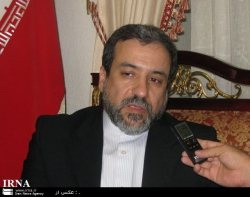
Baku, Aug 25, IRNA – Deputy Foreign Minister in Asian and Oceania Affairs Seyyed Abbas Araqchi said here Friday that Islamic Republic of Iran’s relations with Republic of Azerbaijan have been based on mutual respect over the past 20 years.
Araqchi made the remark in an exclusive interview with IRNA late Friday night.
“Despite the ups and downs in Iran-Azerbaijan political relations, by establishing a Joint Political Consultations Committee, the two sides have thus far had good and constructive consultations in various fields thus far", Araqchi added.
Elaborating on the Iran-Azerbaijan Joint Political Consultations Committee, he reiterated, “The Joint Political Consultations Committee of Iran and Azerbaijan is scheduled to meet once every six months, rotating between Tehran and Baku, at the level of deputy foreign ministers, and to discuss the issues of mutual interest, including the existing problems between the two countries.”
Pointing out that his visit of Baku was aimed at participating at the Joint Political Consultations Committee, Araqchi added, “During the course of my five hour talks with Azerbaijan Republic Deputy Foreign Minister Khalaf Khalafev issues of mutual interest for the two countries, regional and international developments were surveyed and discussed.”
According to him, the existing problems between the two (Muslim neighboring) countries are due to foreign elements, because some foreign countries are opposed to friendly (and brotherly) relations between the Islamic Republic of Iran and the Republic of Azerbaijan, and therefore they try to sow the seeds of discord between Tehran and Baku.
• Necessity of President Aliyev’s presence at NAM Summit
The Iranian deputy FM reiterated, “In the course of my Friday talks with my Azerbaijani counterpart the issue of President Mahmoud Ahmadinejad’s invitation for his Azeri counterpart President Ilham Aliyev was discussed.”
He reiterated, “We believe the presence of the president of Azerbaijan Republic at the Tehran 16th NAM Summit would leave a very positive and constructive effect on Tehran-Baku relations.”
Araqchi reiterated, “Azerbaijan Republic is a member of the Non-Aligned Movement and the thoughts of Azerbaijan Republic leaders can contribute greatly to the success of the NAM movement.”
The Iranian deputy foreign minister said, “The presence of President Aliyev at Tehran NAM Summit would be a turning point contributing to solving of many existing problems between the two countries.”
• Expansion of economic ties
Araqchi furthermore emphasized the need for expansion of economic relations between the Islamic Republic of Iran and the Republic of Azerbaijan Republic, saying, “The matter was surveyed in negotiations with Mr. Khalafev, and it was agreed that the first Joint Economic Commission of Iran and Azerbaijan would meet in Baku in the future.”
The deputy FM reiterated, “It was also agreed that the Azeri friends would announce the time for convening of the first Joint Economic Commission of Iran and Azerbaijan.”
According to him the Joint Economic Commission of Iran and Azerbaijan can provide the path for expansion of bilateral economic relations more than ever before.
• Developing cultural relations
Islamic Republic of Iran Deputy Foreign Minister in Asia and Oceania Affairs Araqchi reiterated, “Keeping in mind the existence of lots of cultural commonalties between the two countries, in talks with the deputy foreign minister of Azerbaijan Republic ways for the expansion of cultural relations between the Islamic Republic of Iran and Azerbaijan Republic were surveyed.”
• Meeting with Azerbaijan Republic Foreign Minister
Noting that all in all he had a good round of negotiations with Khalafev, Araqchi said, “Also in a separate meeting with Azerbaijan Republic Foreign Minister Elmar Mammadyarov we decided to resolved the existing problems between the two countries as soon as possible so that a new round of constructive relations between the Islamic Republic of Iran and the Republic of Azerbaijan would begin in very near future.”
• Decision over legal regime of the Caspian Sea
The deputy minister of foreign affairs focusing on the legal regime of the Caspian Sea, said, “Deciding over the legal regime of the Caspian sea is possible only in the presence of the entire five littoral countries of the Caspian Sea is necessary and therefore, signing any bilateral agreement on the matter is ineffective.”
Araqchi emphasized, “Iran all the same believes bilateral negotiations over deciding the legal regime of the Caspian Sea can affect that regime, and therefore Iran continues its negotiations with the littoral countries of the Caspian Sea on the matter, hoping that these talks would lead to making a shared final decision over the legal regime of the Caspian Sea."
• Syrian developments
Pointing out that the Syrian developments were discussed in his talks with the Azeri deputy foreign minister, Araqchi said, “In Syria the demand of the Syrian nation for implementation of basic reforms must be respected and the Islamic Republic of Iran, too, emphasizes that the righteous demands of the Syrian nation must be met.”
He all the same reiterated, “Implementing political reforms amid foreign interference is impossible, particularly more so because these interferences is accompanied with forwarding weapons and money, while any type of interference further complicates the ongoing crisis in that country.”
• Annan’s six point plan still supported
According to the Iranian deputy FM, the political reforms need to be implemented gradually and peacefully, and therefore, the Islamic Republic of Iran still supports the six article plan of the former UN special envoy Mr. Kofi Annan.
Araqchi meanwhile emphasized, “Military intervention is not a solution for the Syrian problems, which are in need of political solutions, and must be solved peacefully.”
Araqchi said, “Syria has always been the forefront for combat against the Zionist regime and it is clearly seen that the Zionist regime is one of the major involved sides in the combat against the Syrian government, which is one major reason why foreign interference, particularly the Zionists’ interference in Syria must be ended.”
• Iran-Azerbaijan relations’ ups and downs
Iran has an embassy in Baku and a consulate-general in Nakhichevan City. Azerbaijan has an embassy in Tehran and a consulate-general in Tabriz. Both countries are full members of the Economic Cooperation Organization (ECO), the Organization of Islamic Cooperation (OIC) and the Non-Aligned Movement (NAM).
Iran and Azerbaijan have had diplomatic relations since 1918. Iran mediated between Armenia and Azerbaijan over the Nagorno-Karabakh conflict.
Iran was one of the first countries to establish full diplomatic relations with Azerbaijan. Following the declaration of the Parliament of Azerbaijan to restore independence of Azerbaijan Republic on October 18, 1991 and in early December 1991, Iranian foreign minister at the time, Ali Akbar Velayati, visited Baku, where he signed a number of agreements on political, economic, and cultural cooperation and pledged to support Azerbaijan's membership in the Organization of the Islamic Conference (now the Organization of Islamic Cooperation). Within the few days after the visit, Iran recognized Azerbaijan on January 4, 1992, upgraded its consulate in Baku to establish full diplomatic relations.
After the rise of Popular Front of Azerbaijan to power in June 1992, the newly-elected President Abulfaz Elchibey endorsed the unification of the Azerbaijani populations of his country and Iranian Azerbaijan, and to that end, autonomy for the Iranian Azerbaijanis, a stance which alienated the Iranian government.
Ironically, Elchibey was against the breakup of his own nation based on ethnic lines, stating 'Armenians have been living in Azerbaijan for centuries, and as full citizens of the state - just like the Lezgins, Tats, and Talyish... let them continue to live here as equal citizens before the law - but they must obey the laws of the state, no country would demand any less. He also denounced Iran's peace efforts during the Nargorno-Karabakh conflict, claiming Iran was attempting to give Armenia the advantage. However, during Nagorno-Karabakh War, Iran pressured Armenia and Karabakh Armenians to halt the offensive. Veiled threats first appeared in the English-language Kayhan International:
“If our peace and border security is going to be threatened... our leaders cannot afford to let the situation take care of itself.”
This statement was followed by official warnings from the Iranian Foreign Ministry, accompanied by military reinforcements along Iran's borders with Azerbaijan and Armenia. Iran also gave financial aid to Nakhchivan and pressured Armenia to refrain from attacking the enclave.
Since then however, the two nations have had relatively good relations, although tensions have sometimes been high, cooperating in many different areas including trade, security, and the energy sector. However, some tensions include the growing relationship between the United States, Israel, and Azerbaijan, Caspian Sea territorial issues, and Iran's support for Armenia. President Ilham Aliyev of Azerbaijan had said that he did not support a United States attack against Iran.
Novruz Mamedov, Azerbaijani presidential international affairs department head in 2005, has also said that Azerbaijan would not allow the United States to build bases within Azerbaijani territory and would not help in an attack against Iran.
In May 2005 Baku and Tehran signed a non-aggression pact barring third countries from using their territories for offensive operations against each other.
In March 2006, during the World Congress of Azerbaijanis convention in Baku, a number of participants addressed both the concept of a 'unified Azerbaijan' and 'human rights abuses' against Azeris in Iran. Certain anti-Iran claims during an official seminar in Baku were harmful to relations between the two countries and were especially against the interests of the Republic of Azerbaijan
Nevertheless, the relations between the two republics are once again developing.
On December 20, 2005 Azerbaijani President Ilham Aliev and Iranian President Mahmoud Ahmadinejad attended the opening ceremony of a new gas pipeline from Iran to Azerbaijan's landlocked Nakhchivan Autonomous Region, which is separated from the mainland of Azerbaijan by a strip of Armenian territory. Nakhchivan has been cut off from gas supplies as a result of the Armenia-Azerbaijan conflict over Nagorno-Karabakh. Under a 25-year swap contract signed between the two countries in August 2004, the new pipeline will supply the region with Iranian natural gas. Azerbaijan will also deliver its gas to Iran's northeastern provinces. The volume of gas imports to Nakhchivan is expected to reach 250 million cubic meters in 2006 and 350 million cubic meters in 2007.
On February 3, 2007 Azerbaijan’s minister of communications and information technology, Ali Abbasov, and the head of the Iranian State Broadcasting Agency, Ezzatollah Zarghami, signed a Memorandum of Understanding (MOU) on bilateral media cooperation.
On March 19, 2007, President Mahmoud Ahmadinejad of Iran joined President Robert Kocharyan of Armenia to inaugurate a gas pipeline to pump Iranian natural gas to Armenia. Armenia is Azerbaijan's arch-foe.
Azerbaijan's reel of Eurovision Song Contest 2009 depicted the Maqbaratoshoara, a famous monument and a symbol of the Iranian city of Tabriz and the northwestern region of Iran, shown among Azerbaijani national monuments. This has been perceived by many Iranians as a violation of Iranian territorial integrity.
On November 11, 2009, Iran unilaterally lifted visa regime for Azerbaijani citizens. /end
(Courtesy: Wikipedia for the background on Iran-Azerbaijan relations)
