



Iran says US directly responsible for escalation of tensions in region
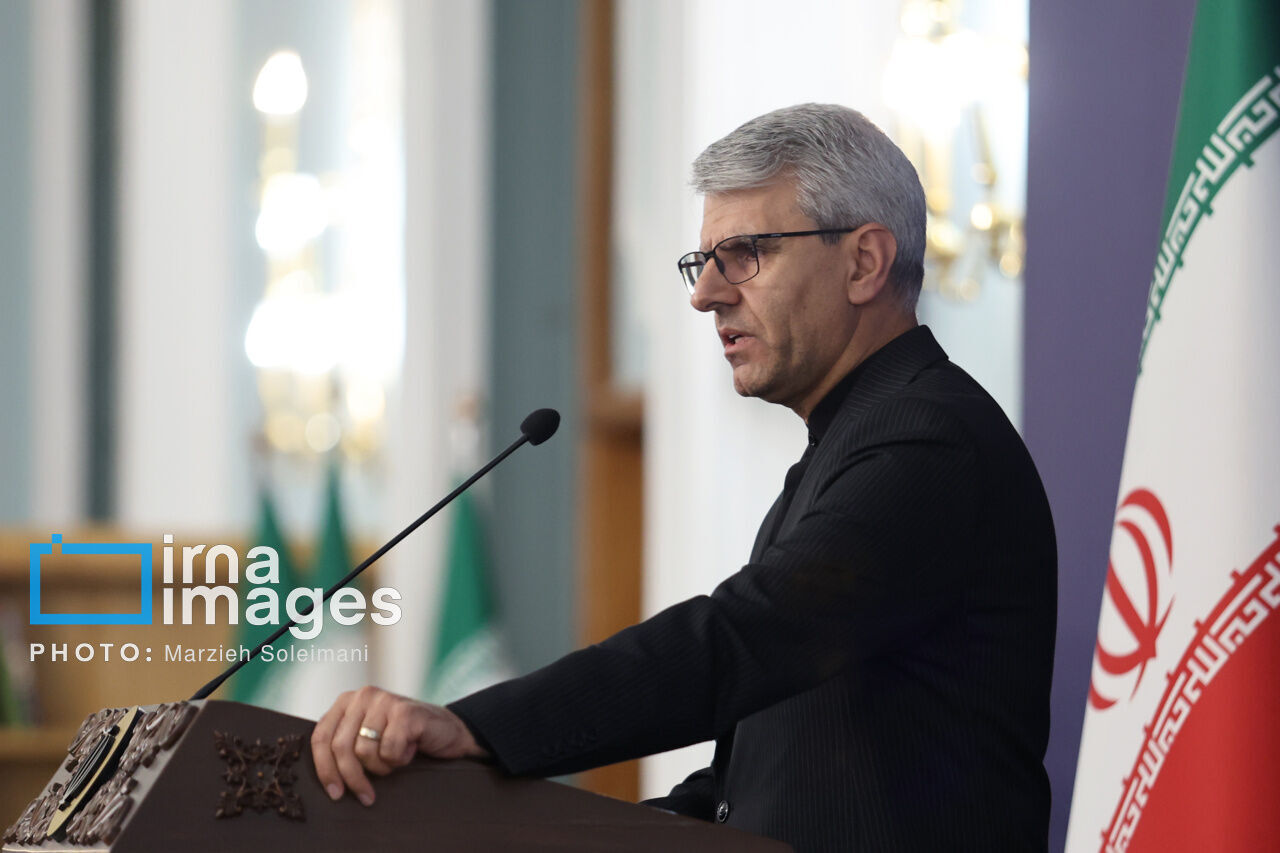
Foreign Ministry spokesperson Esmaeil Baqaei says the United States bears direct responsibility for any escalation of tensions and the resulting consequences in the West Asia region.
Baqaei made the remarks on Monday during his weekly press briefing in Tehran, as a new wave of strikes and counterstrikes between Iran and Israel continues.
On Sunday evening, Iran launched strikes against military targets in Israel in response to the regime’s repeated violations of a ceasefire that took effect on April 8 and also covered Lebanon. Iran said the operation came in response to Israel’s continued attacks on Lebanon, as well as Washington’s violations of the ceasefire through strikes on targets in southern Iran in recent weeks.
“The responsibility of the United States, as a party to the April 8 ceasefire understanding, is undeniable. Whatever happens in our region — whether the US itself violates the ceasefire through attacks on Iranian commercial ships and assaults on the country’s southern regions, or whether such actions are carried out by the Zionist regime in Lebanon, or through collusion with the US in our own region — the direct responsibility of the United States is clear, and the consequences of any escalation will also rest with the United States,” Baqaei said.
He also lashed out at the US for its contradictory statements regarding talks with Iran aimed at permanently ending the war, which began in early April.
“What has happened over the past 24 hours will only further aggravate the already troubled state of the diplomatic process,” said Baqaei, adding that Israeli actions cannot be separated from US policies.
Iran is ready for any situation
The spokesperson also said that the exchange of messages had not ceased prior to the latest escalation, emphasizing that Iran will continue to act as long as it deems such measures necessary.
“We will certainly act wherever necessary, wherever our national interests require it, and wherever our security and national security deem it necessary,” he said, stressing that Iran cannot allow the United States or Israel to repeat their acts of aggression or expand their scope.
“Our Armed Forces, the diplomatic apparatus, and all institutions of the Iranian nation and the Islamic Republic are prepared to confront any situation in order to safeguard the country’s security and national interests.”
Claims about confiscating Iran’s assets ‘absurd’
Responding to reports about alleged US efforts to seize part of Iran’s frozen assets and tie their release to the final stages of the negotiations, the spokesperson said the claims were part of a media and pressure campaign pursued by the opposing side, adding that much of it originates from Israel.
Baqaei described the claims as “absurd,” saying Iran holds regional parties involved in the US-Israeli aggression against the country responsible and will pursue its claims through all available means.
He also stressed that the issue of Iran’s frozen assets remains an integral part of any potential agreement currently under negotiation, and that Tehran will show no leniency on the matter.
Iran’s stance on US-pushed IAEA resolution
Further in his presser, the spokesperson said Tehran is prepared for any outcome if the United States pushes for an anti-Iran resolution at the ongoing quarterly meeting of the Board of Governors of the International Atomic Energy Agency (IAEA).
He criticized IAEA Director General Rafael Grossi for maintaining what he called a “highly inappropriate and unconstructive” approach toward Iran’s nuclear program.
The spokesperson said Grossi is ignoring the root causes of the current situation –namely US and Israeli attacks on Iran’s peaceful nuclear facilities – while focusing only on the consequences. He also criticized the IAEA for failing to condemn those attacks, saying the agency’s double standards reinforce perceptions that it is acting in a political and biased manner rather than a technical one.
Israel’s spying on US shows regime doesn’t believe in diplomacy
Baqaei also responded to questions on reports that the Pentagon had assessed Israel’s counterintelligence threat level as “critical,” including allegations that Israel had spied on Steve Witkoff, US President Donald Trump’s envoy in talks with Iran.
According to the spokesperson, Israel’s spying activities show that the regime does not believe in any diplomatic process that could bring even a small degree of calm to West Asia.
He said that throughout the history of diplomatic efforts surrounding Iran’s nuclear issue over the past 20 years, Israel has consistently acted openly as a disruptive and destructive force against any diplomatic process.
Baqaei also said the matter was a dispute to be resolved between the United States and Israel, but the international community, regional countries, and public opinion would certainly draw lessons from the reports about which actor in the region is actively working to sabotage every diplomatic effort.
Regional states must not playing into enemy’s hands
The spokesperson urged Egypt and other regional countries not to “unknowingly play into the enemy’s hands,” saying credibility in the Arab and Islamic world comes from correctly identifying friends and foes, not from threatening a Muslim country confronting Israel.
He made the remarks while responding to reports that Egypt had deployed missile and air defense systems in the UAE and that Egyptian President Abdel Fattah el-Sisi had recently appeared in photographs alongside Egyptian fighter jets, as well as criticism from Cairo toward Iran.
Iraq’s sovereignty key to Iran’s national security
Responding to a question about reports that some Iraqi resistance groups had decided to hand over their weapons to the Iraqi government, Baqaei said preserving Iraq’s sovereignty, territorial integrity, and national security is essential not only as a matter of good neighborly relations, but also for Iran’s own national security.
He said Iraqi resistance groups, alongside the Iraqi government, played a major role in defending the country against the Daesh terror group and foreign interference, adding that their role would be remembered by the Iraqi people and the wider region. Baqaei also said recent regional developments had offered important lessons on national cohesion and security.
Foreign minister’s diplomatic contacts continue
On Foreign Minister Abbas Araghchi’s diplomatic contacts in recent hours, Baqaei said that “undeclared contacts” will continue.
As for the declared contacts, their aim is to alert the international community and regional countries to a dangerous situation imposed by Israel on the region and on international peace and security.
No Iranian attack on Saudi airbase
On a question about an alleged Iranian attack early Monday on Saudi Arabia’s Prince Sultan Airbase that houses American forces, the spokesperson rejected the allegations and said the Iranian Armed Forces publicly announce whatever action they take, and that they have not made any announcement regarding the attack.
He also reiterated warnings about false-flag operations by Israel or other parties, which he said are aimed at creating divisions among regional countries.
Albania interference claims ‘stereotypical’
Baqaei dismissed allegations of Iranian involvement in developments in Albania, including claims linked by some media to protests dubbed the “Flamingo Revolution” and remarks by the Albanian prime minister accusing Tehran of fueling unrest.
Baqaei called the accusations a “stereotypical pattern,” adding that such claims are repeatedly raised by governments seeking closer ties with Israel. He added that Albanian authorities are deflecting domestic criticism and that their public is aware of these “baseless accusations.”
Reports of enriched uranium transfer are ‘media speculation’
The spokesperson said that the ongoing Iran–US talks are currently focused on ending the conflict, reiterating that this has been the central theme of the negotiations.
Responding to questions about whether prisoner exchanges are being discussed and whether Iran has agreed to transfer its enriched uranium abroad, Baqaei said such claims are purely media speculation.
Germany’s stance on Israel influenced UN Security Council vote outcome
Baqaei said the election of five new non-permanent members to the UN Security Council will shape the body’s future approach, expressing hope that it will lead to greater responsibility and an end to selective treatment of regional issues. He welcomed Kyrgyzstan’s first-ever election to the Council and congratulated Zimbabwe as an important African member.
Commenting on Germany’s failure to secure a seat, Baqaei said the outcome reflects broader international reaction to Berlin’s policies, particularly its support for Israel’s actions in Gaza and the justification of crimes against Iran and the Palestinian people.
Iran committed to repairing ties with neighboring countries
The spokesperson said Iran is determined to restore and strengthen relations with regional countries, stressing that good-neighborly policy remains a fixed principle of Iran’s foreign policy.
Responding to a question on rebuilding trust in the region amid what was described as Israeli and US lobbying efforts, Baqaei said Iran had repeatedly warned neighboring states not to allow their territory or facilities to be used for attacks against Iran, but those warnings were not heeded.
He added that despite recent developments, Iran continues to view regional states as permanent neighbors with shared historical, cultural and religious ties, and remains committed to efforts aimed at building a region based on collective and regional security.
