



Major Powers Must Uphold International Law Consistently, Says Minister Mohamed Khaled
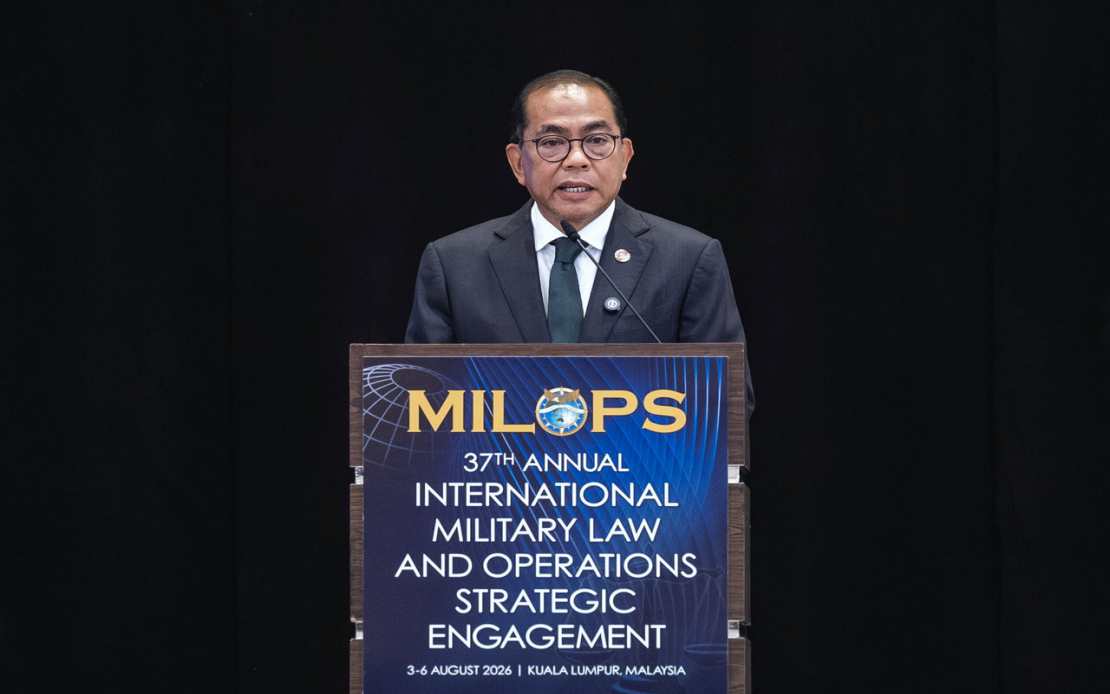
KUALA LUMPUR, Aug 3 (Bernama) -- Major global powers must exercise their military capabilities responsibly and uphold international law and rules-based orders consistently rather than selectively, said Malaysia’s Defence Minister Mohamed Khaled Nordin.
He said Malaysia regarded countries with significant military capabilities as custodians of global peace and stability, a recognition that came with great expectations and responsibilities.
“We do not presume to tell you how you should conduct your foreign policy and international affairs.
“But we expect you to do so while respecting international laws and rules-based orders, consistently, not selectively,” he said in his welcoming remarks at the 37th Annual International Military Law and Operations Conference (MILOPS) 2026, here on Monday.
Mohamed Khaled said the message should resonate throughout the four-day conference, which brings together defence leaders, military officials, national security practitioners, legal experts, policymakers and scholars from across the Indo-Pacific and beyond.
He also stressed that no meaningful Indo-Pacific dialogue could take place without a peaceful and united ASEAN, noting that Southeast Asia was at the heart of the wider region.
“ASEAN’s stability is fundamental to the stability of this wider region,” he said, adding that ASEAN’s established security architecture must remain the conduit for substantial Indo-Pacific discourse.
Mohamed Khaled said Southeast Asia must continue to remain a Zone of Peace, Freedom and Neutrality (ZOPFAN), a concept proposed by Malaysia under the leadership of the country’s second prime minister, Abdul Razak Hussein.
The vision was proclaimed in Kuala Lumpur by ASEAN’s founding members in 1971 against the backdrop of the Cold War and intense rivalry among major powers.
He said the principle remained relevant more than five decades later, as neutrality and non-alignment had enabled the diverse Southeast Asian region to avoid major conflict, achieve economic growth and strengthen regional cooperation.
“We do not believe that peace requires us to choose sides. Rather, peace requires us to engage all and respect all, while remaining guided by our principles and interests,” he said.
Mohamed Khaled also called on all countries engaging with ASEAN to understand and respect the Treaty of Amity and Cooperation in Southeast Asia (TAC).
Describing the TAC as ASEAN’s code of conduct, he said it embodied the principles of mutual respect, peaceful settlement of disputes, non-interference and cooperation.
He said engagement with ASEAN should be guided by those principles, which had helped the region preserve peace, build trust and foster prosperity for decades.
Meanwhile, addressing the military leaders and officials attending the conference, Mohamed Khaled said the purpose of the military was neither to wage war nor create conflict.
“The true purpose of being in the military is to ensure that war and conflict never become necessary.
“Whenever possible, conflicts must be resolved through peaceful dialogue, mediation and diplomacy, never through war,” he said.
He added that the presence of soldiers and military forces should not be viewed as a demonstration of power or intimidation but as a collective commitment to peace.
Mohamed Khaled said hosting MILOPS in Malaysia reflected the country’s longstanding belief that dialogue and engagement were the strongest instruments for preserving peace and its open-door approach to cooperation based on mutual trust and respect.
Hosted in Kuala Lumpur from Aug 3 to 6 by the US Pacific Command, the MILOPS 2026 conference brings together government officials and military representatives from more than 30 countries to address common security challenges and explore ways to strengthen cooperation in deterring and responding to coercion, aggression and legal warfare in the region.
The conference also focuses on strengthening legal interoperability, expanding combined exercises and enhancing information sharing to build a more resilient and integrated regional security architecture capable of countering aggression and maintaining stability.
– BERNAMA
