



Indonesia develops frankincense oil for premium perfumes
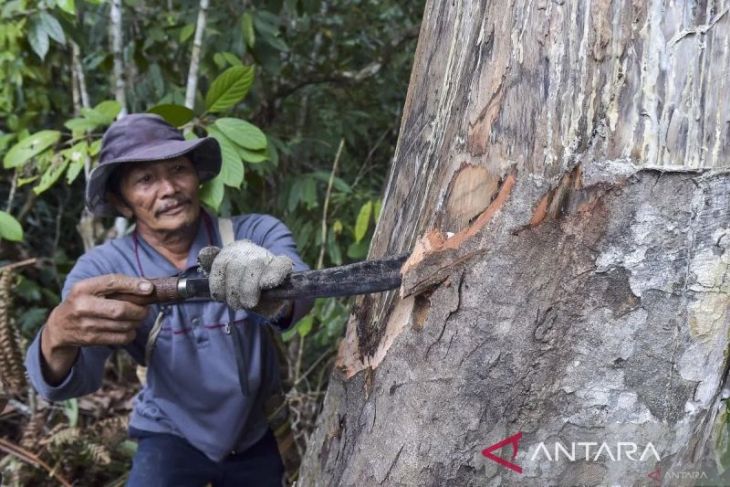
Photo caption: Illustration - A member of a customary forest management institution (LPHA) peels the bark of a frankincense tree in the Nenek Limo Hiang Tinggi Nenek Empat Betung Kuning Muara Air Dua customary forest in Kerinci, Jambi, on Saturday (June 28, 2025).
Jakarta (ANTARA) - Indonesia's National Research and Innovation Agency (BRIN) has developed high-grade essential oil from indigenous frankincense resin—locally known as kemenyan—to produce premium perfumes.
Aswandi, a researcher at BRIN's Applied Botany Research Center, said the extracted oil produces an elegant, bold amber fragrance that bears no resemblance to its traditional association with ceremonial incense burning.
"Even if you visit a frankincense forest, you won't find that 'frightening' smell. It simply isn't there," Aswandi said during a recent agency podcast.
To create luxury fragrances, BRIN uses purified frankincense oil as a base note, blending it with other native Indonesian essential oils—including patchouli, ylang-ylang, jasmine, and citrus extracts—to produce layered, refreshing aromas.
Aswandi noted that Indonesian frankincense features unique phytochemical compounds not present in species found in other regions.
High concentrations of cinnamein, benzyl benzoate, and vanillin give the local resin strong potential to compete in the global fragrance industry.
Despite this potential, Indonesia continues to export most of its frankincense as raw resin—shipping between 5,000 and 6,000 metric tons annually to 60 countries—rather than processing it into higher-value finished goods.
Consequently, Indonesia imports expensive foreign cosmetics and perfumes, many of which use Indonesian frankincense as a key raw ingredient, he added.
Beyond fine fragrance, BRIN’s research indicates that frankincense-based formulations offer therapeutic benefits, such as promoting relaxation, boosting focus, and aiding skin regeneration.
BRIN is encouraging small and medium-sized enterprises to adopt its patented purification technology, aiming to build a home-grown fragrance industry and shift the plant's image away from mystical rituals toward high-value commercial markets.
"We have patchouli, citronella, and frankincense growing here. Why not make our own perfumes and aromatherapy products?" Aswandi said. "That would reduce import dependence while creating new opportunities for our creative economy."
