



Indonesia secures US$350 million Australian investment in Batang SEZ
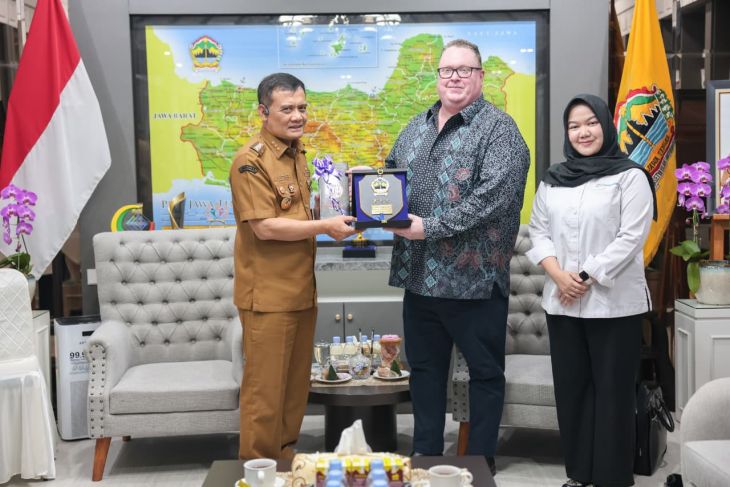
Photo caption: Central Java Governor Ahmad Luthfi (left) and Chairman of Pure Battery Technologies Stephen Wilmot (center) hold a meeting in Semarang, Central Java, on Monday (August 3, 2026).
Semarang, C Java (ANTARA) - The Central Java provincial government announced that Australia-based Pure Battery Technologies (PBT) has committed to investing US$350 million in the Batang Special Economic Zone (SEZ).
Central Java Governor Ahmad Luthfi stated on Monday that the investment will fund a production facility for precursor cathode active materials (pCAM), a key component used in manufacturing lithium-ion batteries for electric vehicles (EVs) and solar energy storage systems.
The facility is projected to employ 1,000 workers during its construction phase, which is scheduled to commence in 2027.
Luthfi noted that the investment aligns with the province's renewable energy development goals, expressing hope that the factory's output will not only target export markets but also fulfill domestic demand.
"Our local industries should be able to source their manufacturing materials from this facility to stimulate the domestic economy," Luthfi said during a meeting with PBT executives.
The governor emphasized that the renewable energy and EV markets in Central Java hold immense potential, given the province's population of approximately 38 million across 35 districts and cities.
Furthermore, the provincial government continues to promote the installation of solar panels on government buildings while exploring floating solar projects on reservoirs and lakes. The province also plans to transition its public transportation networks to electric vehicles.
Meanwhile, PBT Chairman Stephen Wilmot noted that the company is currently in the engineering phase to prepare for factory construction.
Once operational, the factory is expected to employ around 200 permanent workers, excluding personnel in supporting sectors such as logistics, transportation, and shipping.
"We do not want to bring in workers from other countries. We want to train local people so they can work in our factory," Wilmot said.
According to Wilmot, the Central Java project marks PBT's largest investment to date. The scale of the Batang facility is expected to be more than four times larger than the company's refinery in Germany.
The plant is projected to generate approximately US$900 million in annual revenue, though actual figures will depend on nickel price fluctuations.
PBT plans to source raw nickel from Indonesia to build a comprehensive battery supply chain. The resulting materials will be suitable for EV and bus batteries, as well as grid-scale energy storage systems.
"We want to establish the entire electric vehicle value chain, including the management of end-of-life batteries. We aim to conduct recycling to ensure no environmental issues arise," Wilmot said.
