



Manufacturing, consumption drive Indonesia's 5.29 percent Q2 growth
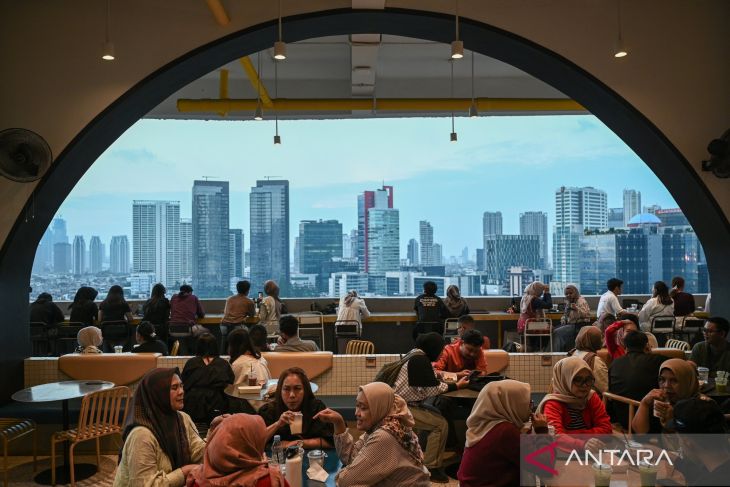
Photo caption: Visitors enjoy meals at a dining spot in Kuningan City Mall, Jakarta, Saturday (June 13, 2026).
Jakarta (ANTARA) - Indonesia's economy grew 5.29 percent year-on-year in the second quarter of 2026, driven primarily by manufacturing activity and household consumption, official data from Statistics Indonesia (BPS) showed on Wednesday.
Speaking at a press briefing in Jakarta, BPS Deputy for National Accounts and Statistical Analysis Moh. Edy Mahmud said gross domestic product (GDP) reached Rp 6,552.1 trillion (US$365.3 billion) at current prices and Rp 3,576.2 trillion (US$199.3 billion) at constant prices during the April–June period.
On the production side, manufacturing was the largest contributor to growth, adding 0.90 percentage points after expanding 4.52 percent from a year earlier.
The sector accounted for 18.50 percent of total GDP.
Wholesale and retail trade contributed 0.83 percentage points, followed by construction at 0.62 percentage points and information and communications at 0.48 percentage points.
On the expenditure side, household consumption remained the primary growth driver, contributing 2.67 percentage points after rising 5.06 percent year-on-year.
Household spending made up 53.32 percent of GDP.
Gross fixed capital formation (investment) added 2.06 percentage points to growth, while government consumption contributed 1.07 percentage points.
Net exports subtracted 0.78 percentage points from overall growth as imports outpaced exports.
The regional momentum aligns with broader projections by the International Monetary Fund (IMF), which forecast in its July 2026 World Economic Outlook that the global economy will expand by 3.0 percent this year.
The IMF expects emerging market and developing economies to outpace the global average with 3.8 percent growth in 2026, though inflation in these markets is projected to remain elevated.
