



Bank Indonesia stresses stability for investment at G20 FMCBG meeting
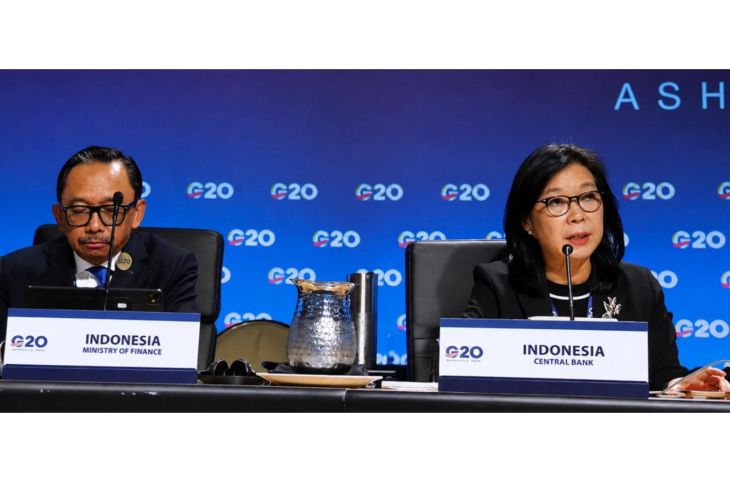
Photo caption: Bank Indonesia Deputy Governor Filianingsih Hendarta (right) and Deputy Minister of Finance Juda Agung (left) take part at the G20 Finance Ministers and Central Bank Governors (FMCBG) meeting in Asheville, North Carolina, the United States. (ANTARA/HO-Bank Indonesia)
Jakarta (ANTARA) - Bank Indonesia (BI) underscored economic stability and policy certainty as critical foundations to attract investment, create jobs, and bolster business resilience during the G20 Finance Ministers and Central Bank Governors (FMCBG) meeting in Asheville, North Carolina, the United States.
Speaking on behalf of the central bank governor, BI Deputy Governor Filianingsih Hendarta stated that a clear policy framework is essential for navigating ongoing global economic uncertainty.
In a statement on Wednesday, BI emphasized three main strategies in executing monetary policy amidst global turbulence:
First, the central bank focuses on keeping inflation expectations anchored through forward-looking, comprehensive assessments. Anchored inflation refers to a state where price increases remain stable and within target ranges.
Second, BI is adapting its monetary framework to keep pace with rapid digitalization and deepening global financial integration.
The central bank noted that these trends underscore the necessity of a "policy mix"—integrating monetary strategy, exchange rate stabilization, macroprudential tools, and payment system policies.
Third, BI is reinforcing transparent, consistent, and credible policy communications to anchor market expectations and improve monetary policy transmission.
Hendarta attended the high-level talks held from August 31 to September 1, 2026, alongside Deputy Minister of Finance Juda Agung, who represented the government.
The summit convened G20 members, key international financial institutions, and guest nations, including the Netherlands, Poland, Singapore, Qatar, Switzerland, and the United Arab Emirates.
While delegates noted that the global economy shows resilience, the G20 issued a cautious outlook, pointing to persistent headwinds such as geopolitical friction, energy and trade disruptions, stubborn inflation, heavy debt burdens, and financial market volatility.
To counteract these vulnerabilities, G20 leaders called for closely calibrated monetary and fiscal policies paired with structural reforms, supply chain diversification, and targeted investment in innovation.
Artificial intelligence emerged as a primary focus, with officials identifying AI as a critical engine for future productivity.
However, delegates cautioned that rapid adoption must be balanced with robust cybersecurity measures and safeguards to preserve financial system stability.
The group concluded with a pledge to deepen international cooperation on pressing systemic issues, including global trade imbalances, debt relief, digital financial fraud, and expanded private-sector partnerships to secure long-term, sustainable growth.
