



(News Focus) Kia eyes bigger share of commercial vehicle market with PBVs
By Kim Eun-jung
HWASEONG, South Korea, Sept. 9 (Yonhap) -- Kia Corp. is seeking to tap deeper into the global commercial vehicle market by industrializing vehicle customization, betting that flexible manufacturing and integrated conversion can give it an edge in a market long dominated by established vanmakers.
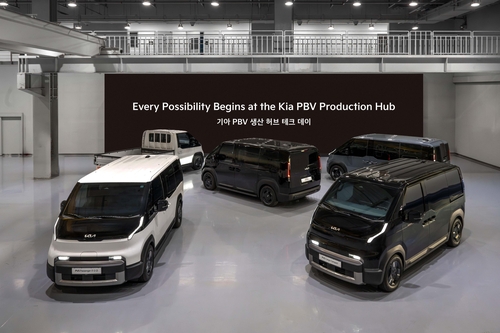
At the center of the strategy is Kia's purpose-built Platform Beyond Vehicle (PBV) production hub at AutoLand Hwaseong, about 60 kilometers southwest of Seoul. The hub combines dedicated PBV production plants with an adjacent conversion center that tailors electric base vehicles to specific customer needs.
Unlike conventional commercial vehicles that are typically mass-produced and later modified by outside bodybuilders, Kia designs its PBVs from the outset with conversion in mind, aiming to reduce costs and production time while offering vehicles tailored for logistics, passenger transport, camping and other uses.
At AutoLand Hwaseong, a decades-old manufacturing complex that also produces models including the Sorento, Niro, Seltos, K5, K8 and EV6, Kia began mass production of the PV5 at EVO Plant East in August 2025.
The roughly 100,000-square-meter plant has an annual capacity of 100,000 vehicles and can produce multiple PV5 variants on the same line, including Passenger, Cargo, Wheelchair Accessible Vehicle and Chassis Cab models.
At the plant, yellow robotic arms moved in synchronized motion along the production line, welding vehicle body parts as sparks occasionally flew from the metal.
After the pre-trim process, camera-equipped automated systems installed doors and tailgates, while vision-based systems inspected vehicles for exterior defects.
Automated equipment also handled sanding and polishing, cable connection checks and headlamp aiming.
On the factory floor, automated guided vehicles (AGVs) moved vehicle bodies and parts between production processes, following preset routes without human drivers.
Next to the East plant, Kia is building EVO Plant West, which will produce the PV7 once completed in June 2027.
The new facility will also have an annual production capacity of 100,000 vehicles, bringing the two EVO plants' combined base-vehicle capacity to 200,000 units a year.
Kia's investment in the production hub underpins its push into the global light commercial vehicle sector, long dominated by manufacturers such as Ford Motor Co., Mercedes-Benz, Stellantis, Renault and Volkswagen.
The shift toward electric commercial vehicles could provide an opening for newer entrants as fleet operators increasingly seek customized vehicles for last-mile delivery, passenger services and other specialized purposes.
Kia is betting that integrating mass production with conversion at the same manufacturing complex will allow it to respond more quickly to those diverse customer needs.
"In the commercial and business vehicle market, vehicles are increasingly used for more than just transportation, serving as logistics platforms, work and leisure spaces, and special-purpose vehicles for public services," said Lee Si-young, a senior manager on Kia's conversion model development team, during Tuesday's media tour. "As customer needs vary widely, Kia aims to offer a range of conversion models tailored to different uses."

Reporters take photos during a media tour of Kia's PBV Production Hub in Hwaseong, about 60 kilometers southwest of Seoul, on Sept. 8, 2026, in this photo provided by the automaker. (PHOTO NOT FOR SALE) (Yonhap)
Kia's first dedicated PBV, the PV5, was launched last year and has already gained industry recognition, becoming the first Korean vehicle to win the 2026 International Van of the Year award.
Kia said more than 40,000 PV5 units have been sold globally so far this year, against its full-year target of 54,000 units.
For Kia, the PV5's early performance has provided an initial foothold, but the rollout of larger models will be key to expanding its presence in the global commercial vehicle market.
The PV7, the second model in Kia's dedicated PBV lineup, is set to make its world premiere at the IAA Transportation 2026 show in Germany next week, ahead of its planned launch in 2027. The larger PV9 is scheduled to follow in 2029.
At its CEO Investor Day in April, Kia set a target of selling 232,000 PBVs annually by 2030, with Europe and South Korea serving as its key markets.

So Deuk-young, head of Kia's PBV Production Hub, speaks during a media briefing at the plant in Hwaseong, about 60 kilometers southwest of Seoul, on Sept. 8, 2026, in this photo provided by the automaker. (PHOTO NOT FOR SALE) (Yonhap)
The company has emphasized that its PBV reflects a strategy that extends beyond just vehicle sales but encompasses a whole range of customization, software and comprehensive fleet services that will permit it to solidify its presence in the worldwide commercial vehicle sector.
"The value of PBVs goes beyond the vehicle itself," So Deuk-young, head of Kia's AutoLand Hwaseong, said. "It requires flexible production and conversion capabilities to meet the diverse needs of customers."
ejkim@yna.co.kr
(END)
