



Indonesia exports Brebes shallots to Thailand following supply surplus
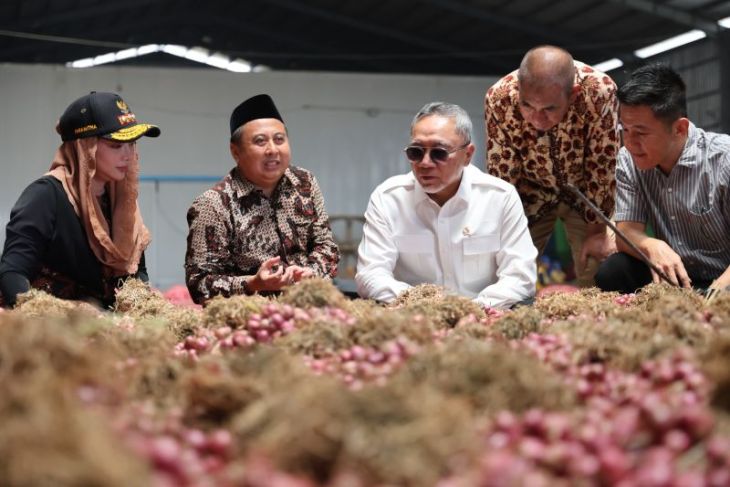
Photo caption: Coordinating Minister for Food Zulkifli Hasan (center) inspects shallots at a controlled atmosphere storage (CAS) facility in Brebes, Central Java. (ANTARA/HO-Coordinating Ministry for Food)
Jakarta (ANTARA) - Coordinating Minister for Food Zulkifli Hasan said shallot exports from Brebes, Central Java, to Thailand have expanded market opportunities for farmers after domestic demand was fulfilled.
"We are grateful that the domestic need for shallots has been met. Now we are pushing for increased production for wider market and better prices, including the export market," he remarked in a statement on Monday.
He conveyed this when reviewing the send-off of shallots to Thailand from a controlled atmosphere storage (CAS) facility in Brebes District.
Hasan explained that Brebes is a major shallot-producing region, accounting for around 20 percent of national production and 60 percent of production in Central Java.
The planting area for shallots in this region ranges from 30,000 to 35,000 hectares per year, with annual production reaching 300,000 to 350,000 tons.
Apart from Thailand, Brebes shallots have been exported to Vietnam, Malaysia, and Singapore.
The minister said efforts to expand exports must consider domestic supply and price stability so that increased production directly benefits farmers.
"Do not let farmers increase production but there is no demand. Therefore, the government ensures market availability, both domestic and abroad," he emphasized.
Based on Food Balance Projections processed by the National Food Agency (Bapanas), national shallot production in 2026 is estimated to reach 1.32 million tons, against consumption needs of around 1.25 million tons.
Bapanas previously noted that national shallot production in 2025 reached 1.43 million tons, with consumption reaching 1.23 million tons, generating a surplus that enabled Indonesia to export 1,560 tons of shallots to global markets.
The government is also working to absorb shallots produced by farmers for the Free Nutritious Meals (MBG) program through the National Nutrition Agency (BGN), helping strengthen the domestic market.
Apart from market expansion, authorities are preparing to improve seed quality and increase shallot productivity, including by reducing dependence on imported seeds.
These efforts aim to support shallot production that meets quality standards required by domestic and export markets.
