



Indonesia targets OECD accession within two years
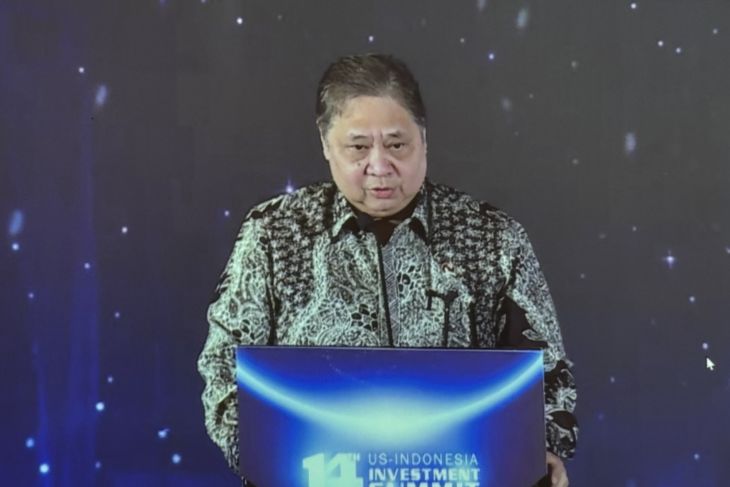
Photo caption: Indonesia's Coordinating Minister for Economic Affairs Airlangga Hartarto delivers a presentation at the 14th United States-Indonesia Investment Summit in Jakarta on Tuesday (October 6, 2026). (ANTARA/Imamatul Silfia)
Jakarta (ANTARA) - Indonesia's Coordinating Minister for Economic Affairs Airlangga Hartarto said the country targets to complete its accession process to the Organisation for Economic Co-operation and Development (OECD) within two years.
Speaking at the 14th United States-Indonesia Investment Summit here on Tuesday, Hartarto explained Indonesia has submitted almost 20 of the 24 chapters that need to be fulfilled to the OECD.
This means the process Indonesia has completed so far is equivalent to 75-80 percent.
"Hopefully, within two years we can complete the OECD membership," Hartarto said.
On the occasion, he also asked for the support of the United States to achieve the target of completing OECD membership for Indonesia.
"Of course, we need the support of the United States to achieve it," he added.
Previously, the Indonesian government targeted to complete the technical review of its accession to OECD membership within the next three to four years.
Hartarto conveyed it when he met OECD Secretary-General Mathias Cormann on the sidelines of the OECD Ministerial Council Meeting in Paris on June 2026.
In the initial information gathering phase, Indonesia has received 20 questionnaires from the OECD. The OECD has also conducted a fact-finding mission to review environmental policy and public governance.
At the meeting, Hartarto presented positive results from the first accession review presentation by the Environment Ministry before the OECD Environment Policy Committee in April 2026.
The evaluation showed a high level of alignment, with around 60 percent of Indonesia's environmental policies already in line with OECD legal instruments.
Hartarto also affirmed Indonesia's readiness to adapt OECD recommendations, including expanding action plans in the energy, climate change, environmental information, and transboundary pollution sectors.
