



Indonesia brings nations together to tackle cross-border royalties
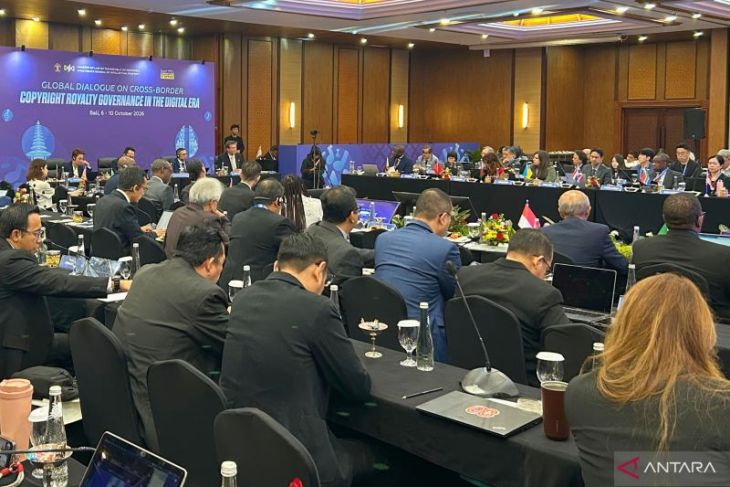
Photo caption: View of the opening of the "Global Dialogue on Cross-Border Copyright Royalty Governance in the Digital Era" in Badung District, Bali, Wednesday (October 7, 2026). (ANTARA/Agatha Victoria)
Kabupaten Badung, Bali (ANTARA) - Indonesia is hosting a global dialogue titled "Global Dialogue on Cross-Border Copyright Royalty Governance in the Digital Era" in Bali from October 7 to 9, 2026, to discuss the governance of cross-border copyright royalties.
The Directorate General of Intellectual Property of the Ministry of Law is organizing the dialogue to address challenges in managing copyright royalties across national borders.
Hermansyah Siregar, Director General of Intellectual Property, said in Badung District, Bali, on Wednesday that technology has democratized the global distribution of musical works, creating new challenges for royalty governance.
"Our task now is to ensure that the global governance structure democratizes remuneration for these works," Siregar said.
He noted that the use of creative works in the digital space, which increasingly transcends national borders, requires a collaborative approach.
Dialogue among countries and stakeholders, he added, is essential to map key issues and identify opportunities for cooperation in royalty governance.
To that end, Siregar said the forum serves as a platform for exchanging views and identifying collaborative opportunities to address challenges in cross-border royalty management. He outlined three key issues at the center of the discussions: transparency, accountability, and interoperability.
According to him, the three elements are interconnected in ensuring effective cross-border management of information on the use of creative works, royalty administration, and copyright data exchange.
On transparency, participants will exchange experiences regarding data openness on work usage, royalty allocation methods, deduction policies, and cross-border payment reporting and reconciliation.
Meanwhile, accountability discussions will cover oversight of automated systems and algorithms, the resolution of unallocated royalties, audit mechanisms, and dispute resolution.
On interoperability, participants will discuss metadata standardization, the identification of works and rights holders, data exchange infrastructure, and cross-border technical cooperation.
Over the three-day forum, participants will include member states of the World Intellectual Property Organization (WIPO), including the Group of Latin American and Caribbean Countries (GRULAC), ASEAN, Central Asia, the Caucasus and Eastern Europe, the Asia-Pacific Group, and the African Union.
The forum will also bring together intergovernmental organizations, Collective Management Organizations (CMOs) from Singapore, Japan, and China, and stakeholders accredited to the Standing Committee on Copyright and Related Rights (SCCR), as well as creators, practitioners, academics, and technical experts.
Participants will exchange experiences and perspectives through thematic discussions. The forum is not designed as a negotiation platform for producing binding international legal rules or commitments.
The dialogue will produce a "Bali Chair's Summary," outlining the discussions, areas of consensus, and issues requiring further study, as well as a document titled "Possible Pathways for Future Cooperation," detailing potential voluntary collaborations in areas such as information exchange, capacity building, technical assistance, research, and system interoperability.
For Indonesia, the forum is expected to serve as a reference for developing national copyright royalty governance.
For creators, rights holders, and creative industry players, the exchange of international experience could support more transparent and verifiable royalty management.
Globally, the dialogue is expected to open avenues for cooperation in addressing copyright management challenges amid the evolution of digital technology and the growing cross-border use of creative works.
