



(Yonhap Interview) Cuba seeks closer ties with S. Korea amid prolonged U.S. embargo: envoy
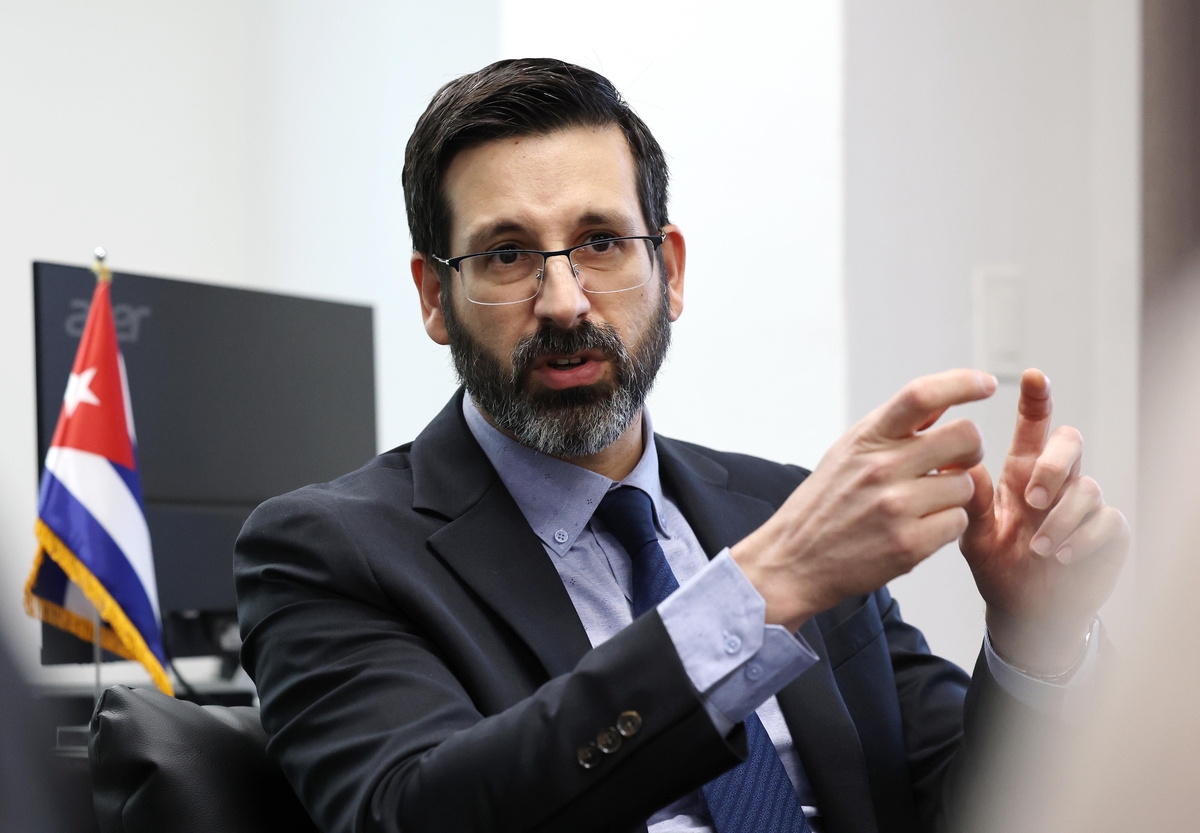
SEOUL, Oct. 22 (Yonhap) -- Cuba is seeking to deepen economic ties with South Korea as it has been grappling with the economic and energy crises exacerbated by decadeslong U.S. sanctions on Havana, the Cuban ambassador to Seoul has said.
Ambassador Claudio Raul Monzon Baeza made the remarks in an interview with Yonhap News Agency in Seoul on Monday, ahead of next week's vote at the U.N. General Assembly on Cuba's annual resolution calling for an end to the U.S. embargo.
"There has been a constant trickle of new measures and sanctions that affect both the public and private sectors," Monzon said. "This is an unprecedented offensive aimed at causing a humanitarian crisis by strangling the economy."
The ambassador said intensified U.S. sanctions have had far-reaching effects on Cuba's trade, fuel supplies and public services, including healthcare. "If not the worst, it's at least one of the worst situations we've been through," he said.
Cuba has submitted an annual resolution against the U.S. embargo since 1992, and this year will be no exception, with a vote scheduled for Oct. 27-28.
"There is a clear and unquestionable consensus in the international community on the need to immediately end this unfair and illegal policy, regardless of governments' political positions or international alliances," Monzon said.
The nonbinding resolution was adopted by 165 votes to 7, with 12 abstentions in October 2025. South Korea has voted in favor of it since 1999.
Monzon said tensions between the two countries could not be understood solely through the lens of ideological differences, pointing to what he described as a long history of U.S. attempts to "colonize and annex Cuba."
In February, U.S. President Donald Trump raised the prospect of a "friendly takeover of Cuba," while U.S. officials have warned of possible military action.
"The only coherent reaction to these recent threats is to be prepared for the military defense of our territory," Monzon said. "We sincerely hope that such a scenario never happens, because military actions against Cuba would cause a war with terrible human consequences."
Havana remains willing to engage with Washington if its sovereignty is respected, though the two countries have yet to make progress toward formal negotiations despite having been in contact, according to the ambassador.
Facing the U.S. embargo and its economic fallout, Cuba is looking to deepen cooperation with South Korea, citing complementarities between the two economies, the ambassador said.
In February 2024, South Korea and Cuba established diplomatic relations in a surprise move that probably dealt a blow to North Korea, which has long boasted brotherly ties with Havana.
"The establishment of official relations (in 2024) is a condition for further developing of nexus in many areas," Monzon said, noting that Cuban agricultural products, biotechnology and critical minerals could find opportunities in the South Korean market.
The two countries were also exploring cooperation in energy, a top priority for Cuba, as well as climate change and environmental knowledge-sharing programs.
"Food production has always been a priority for us because we traditionally do not produce enough food," the ambassador said.
The ambassador also highlighted triangular cooperation projects in the Caribbean involving South Korean financing and Cuban expertise, and pointed to opportunities to expand cultural and sports exchanges.
On Cuba's relations with North Korea following its establishment of diplomatic ties with South Korea, Monzon said Havana viewed its relationship with Seoul as separate from its longstanding ties with Pyongyang.
"The nature of diplomatic relations between Cuba and South Korea is bilateral. Cuba has had and have historical and fraternal relations with the DPRK," he said, adding that Cuba's diverse diplomatic ties posed no conflict or challenge to its foreign policy.
Asked about North Korea's nuclear program, Monzon said Cuba opposed nuclear weapons and called for their complete abolition without singling out any country.
"We don't think that nuclear weapons are the solution. We don't think anyone should have nuclear weapons or develop new nuclear weapons," he said, adding that Cuba also opposed nuclear testing and the development or maintenance of nuclear arsenals.
graceoh@yna.co.kr
(END)
