



Malaysia coordinate with Indonesia on forest fire haze mitigation
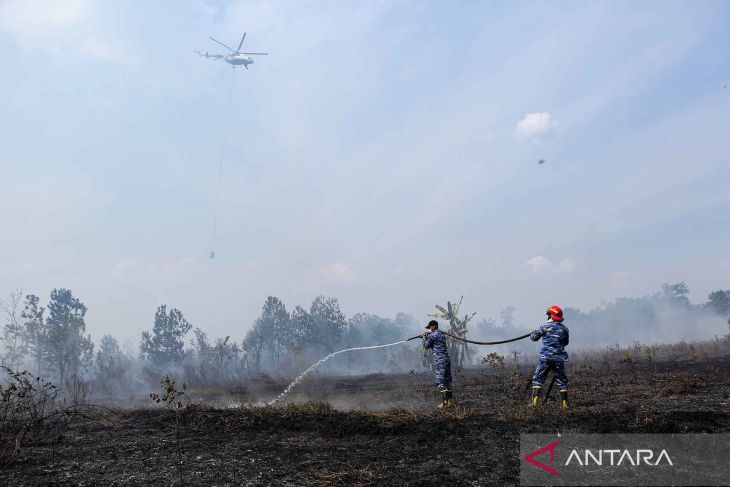
Photo caption: Indonesian Air Force personnel attempt to extinguish forest and peatland fires in Banjar Baru, South Kalimantan, Thursday (Sept 10, 2026). (ANTARA FOTO)
Jakarta (ANTARA) - Malaysia is coordinating closely with Indonesia to mitigate cross-border forest fire haze, deploying border cloud-seeding operations and seeking optimized regional response mechanisms, a Malaysian embassy official said in Jakarta on Tuesday.
"Our environment minister has sent a letter to Indonesia's environment minister and maintained verbal communication with him," said Farzamie Sarkawi, Charge d'Affaires a.i. of the Malaysian Embassy in Jakarta, speaking after a local event.
Sarkawi stated that Indonesian authorities approved Malaysian weather-modification operations along their shared border.
"The work has begun there," he said, expressing hope that the joint efforts in border areas would suppress fires in Kalimantan and reduce smoke drifting into Malaysian airspace.
"We do hope the situation will be better soon. We are also ready to help Indonesia whenever needed."
Forest fires originating in Indonesia's Kalimantan and Sumatra have generated smoke plumes extending across Malaysia, Singapore, Brunei, and into parts of the Philippines. The environmental crisis prompted Malaysia to declare a brief state of emergency in Sarawak’s border region of Serian earlier this month.
At the regional level, Malaysia is working with Singapore and Indonesia to utilize existing protocols under the 2002 ASEAN Agreement on Transboundary Haze Pollution (AATHP). However, Sarkawi noted that collective bloc actions require full consensus among member states.
Indonesia's Ministry of Foreign Affairs confirmed ongoing consultations with neighboring governments to enforce the framework and control transboundary environmental impacts.
